How to Set Your Freelance Rates (And Actually Stick to Them)
Most freelancers start too low and struggle to raise their rates later. Here's how to set your pricing with confidence from the start — and build toward $10K months.
50%
Of freelancers in my
1:1 sessions were undercharging when they arrived
$10k
Monthly income that's
achievable by stacking the right mix of clients
30%
Add this to your hourly rate
to account for self-employment taxes
In over 150 one-on-one coaching sessions, one pattern shows up more than any other: talented freelancers leaving serious money on the table — not because they aren't good at what they do, but because they never took the time to proactively set their rates. They just took what they could get.
Setting your rates isn't just a business decision — it's a confidence decision. When you know your number before a client call, everything changes. You stop bending to their budget. You stop saying yes to work that isn't worth your time. You start building toward real income goals instead of just surviving month to month.
"The biggest mistake freelancers make is not setting their rates upfront and instead bending to clients' budgets. Know what your work is worth before you talk to anyone."
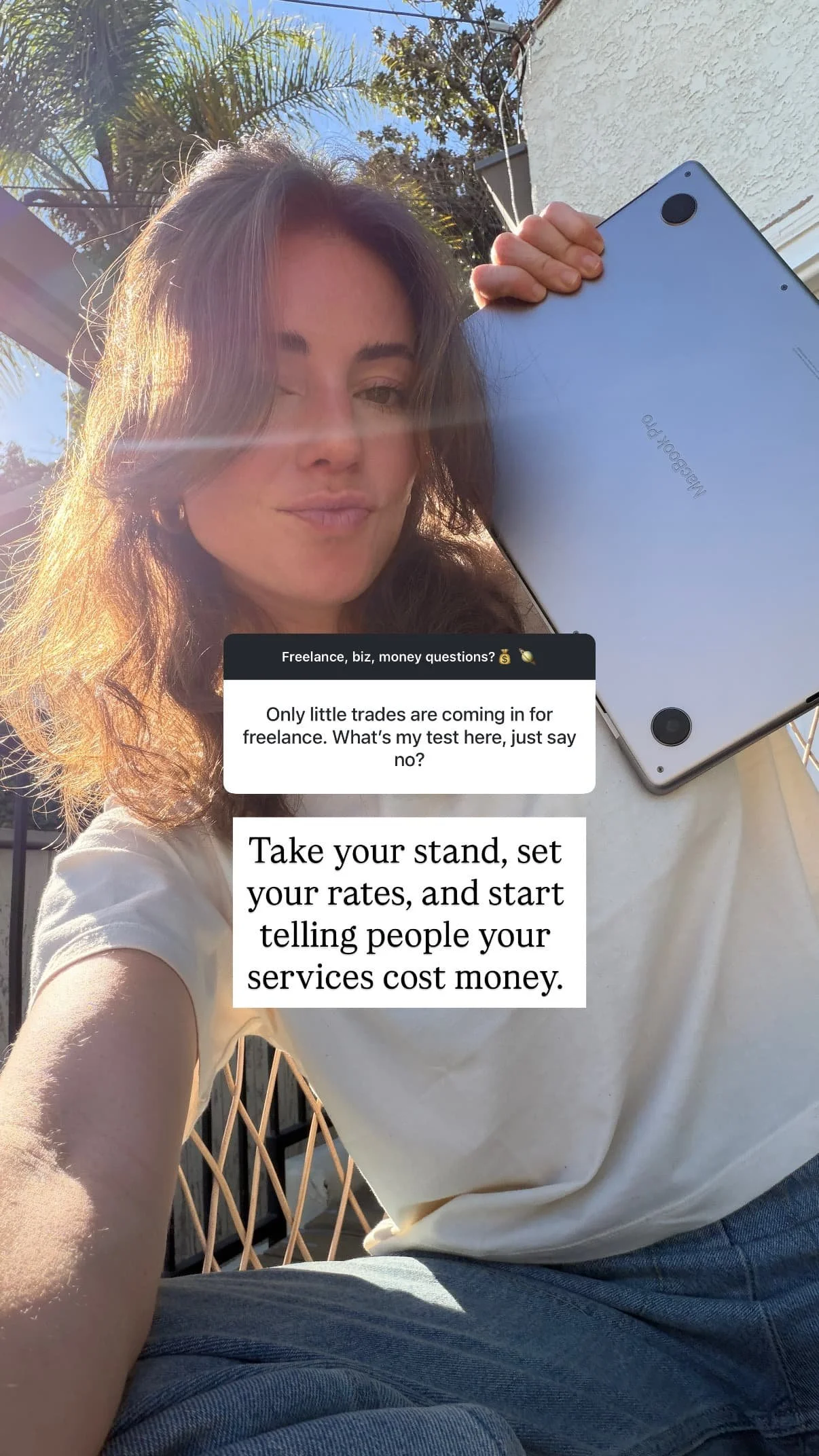

Step 1 — Figure out your baseline number
Before you set a rate, you need to know two things: how much it costs to be you every month, and what the market pays for your services. Everything flows from there.
Calculate your monthly expenses: rent, utilities, groceries, insurance, loans — everything. This is your minimum monthly income target. Once you know it, your rate decisions become much clearer.
Research market rates for your service: use Claude - my personal fav AI tool ("What is the market rate for [my service] in [my state]?"), ask peers what they charge, and look at what companies hiring for similar roles are paying.
Take your previous salary and add 30%: if you were making $75K/year on salary, that's roughly $36/hour. Add 30% for self-employment taxes and you get ~$47/hour as a starting point.
Find your expander: talk to someone at your skill level and see what they charge. If they're charging more than you — raise your rates. They're getting clients at that rate. So can you.
When I started freelancing I was charging around $50 an hour — until I found out a freelance designer I worked with was charging $80 an hour. I was just as good as she was. So I raised my rates immediately to match hers. She was my expander. That one conversation changed everything.
Be nosy. Talk about money. Tactfully find out what people charge — it's the fastest way to understand what the market will bear and what you're leaving on the table.
Inside the course: the exact rate-setting formula
A step-by-step worksheet for calculating your hourly rate, day rate, project fees, and retainer pricing — all from one number.
Step 2 — Choose your pricing model
There's no single right way to price your services. The best approach depends on the project, the client, and where you are in the relationship. Here are the five models to know:
Model 1 — Hourly Rate For every hour I work, I make a set dollar amount. The most common starting point for new freelancers — and the easiest to explain to clients. Best for: new client relationships, exploratory projects, work with unclear scope.
Model 2 — Day Rate A set amount for a full day of my time. Multiply your hourly rate by 8 to start. Consider adding an overtime clause if you anticipate long days. Best for: photographers, directors, producers, on-site work, shoot days.
Model 3 — Project / Deliverable-Based A flat fee for a defined deliverable — a website, a brand identity, a content calendar. I recommend charging 50% upfront and 50% on completion. Requires a clear scope of work. Best for: defined projects with clear deliverables and timelines.
Model 4 — Retainer Agreement A monthly fee for ongoing access to my time and services. The holy grail of freelance income — predictable, recurring revenue that covers your bills. To set yours: decide on monthly hours × your hourly rate, then consider a small discount for the commitment. Best for: ongoing client relationships, fractional team member roles.
Model 5 — Value-Based Pricing Pricing based on the long-term impact of my work, not the hours I put in. If I'm helping a client 10x their revenue — that's worth more than a day rate. Reserved for high-level strategy and work that directly drives business results. Best for: brand strategy, fractional leadership, executive coaching, high-impact creative direction.
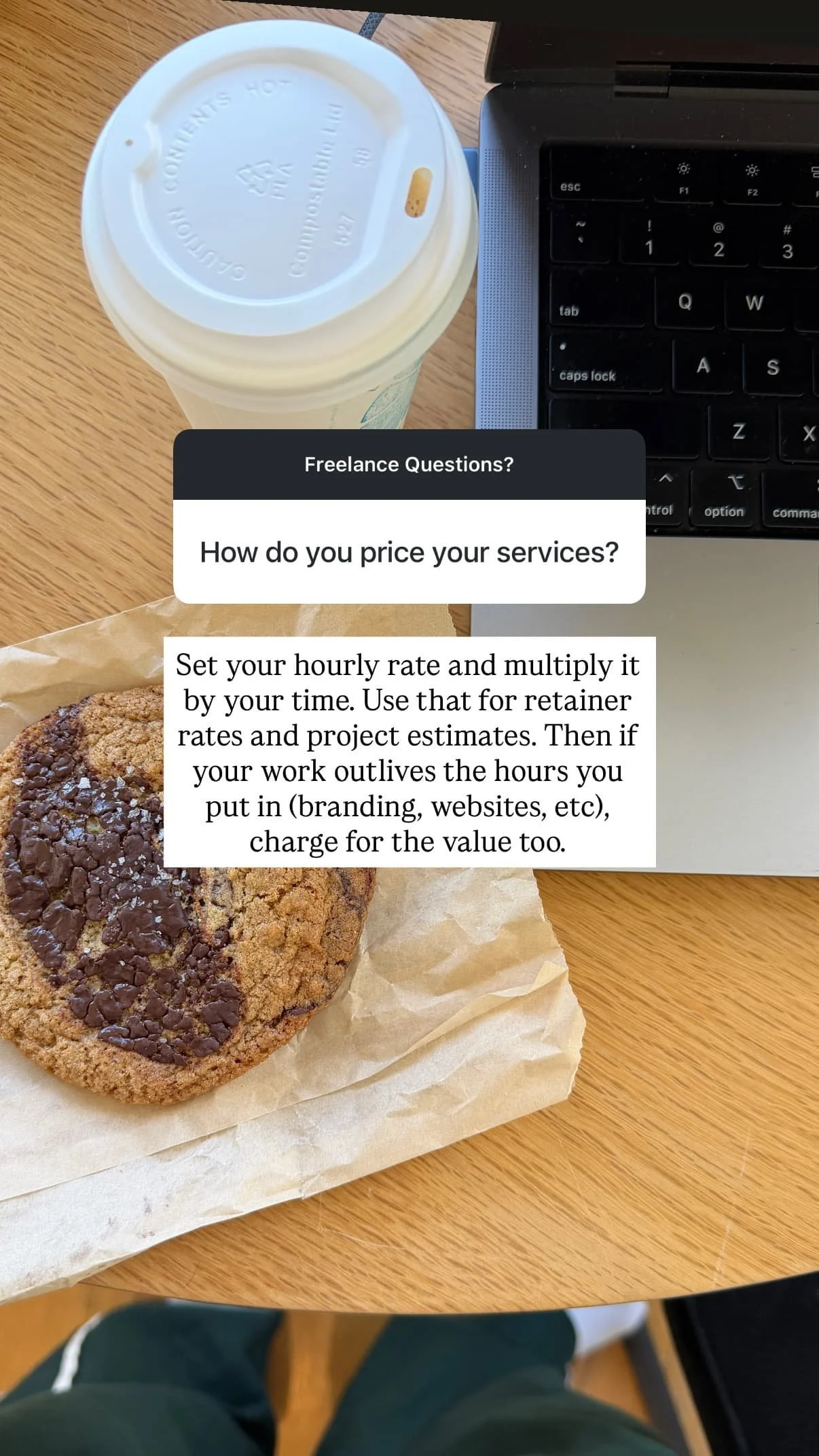

Step 3 — Build a rate sheet
Once you have your rates, put them in writing. A rate sheet is a document that clearly lists your services and prices — think of it like a menu. When a client asks what you charge, instead of fumbling for an answer on the spot you can say "Let me send you my rate sheet" and follow up professionally in writing.
This does two things: it removes the awkwardness of saying numbers out loud, and it demands more respect for your work. Prices in writing feel official. Official feels non-negotiable.
Inside the course: done-for-you rate sheet template
A Google Doc template you can copy, customize with your services and prices, and send to clients as a PDF.
Ready to set your rates with confidence?
The How to Go Freelance course includes a full pricing guide, rate sheet template, and the exact formula I use with my 1:1 coaching clients.
Includes rate sheet, SOW template, contract, client outreach tracker + lifetime access
Step 4 — Think in monthly revenue goals, not hourly rates
Once you have your hourly rate, zoom out. The real game is building a mix of clients that gets you to your monthly income goal — and designing a workload that fits the life you want.
Here's how to think about it: if your goal is $10K/month and your hourly rate is $100/hour, you need 100 billable hours per month. But if you raise your rate to $150/hour, you only need 67 hours. Or you could mix a retainer client at $4K/month with two project clients at $3K each. There are many paths to the same goal — the key is to see them clearly and design toward one intentionally.
The $10K/month Tetris
Think of your services like Tetris pieces. You're not looking for one big client to save you — you're stacking different types of work to hit your monthly goal. A retainer that covers your bills, a project or two for extra income, maybe a 1:1 session here and there.
Freelancing can be just as stable as a full-time salary when you actively build your business — instead of passively waiting for work to come to you.
Stop saying yes to someone's proposed budget. Start creating your own scope of work, calculating your rates, and letting the client know how much your services cost.
Step 5 — Raise Your Rates
If you haven't raised your rates in a while and you're genuinely good at what you do — it's time. Push through the fear and do it. The yeses you get will surprise you, and you'll wonder why you didn't do it sooner.
For existing clients, a simple email works: "As of [date], my rates will be moving to [new rate]. I'm so grateful for our working relationship and wanted to give you advance notice." Most good clients will respect it. The ones who don't react well are usually the ones you've outgrown anyway.
Inside the course: how to raise your rates without losing clients
The exact script for telling existing clients about a rate increase — plus how to handle pushback gracefully.
"I just had my first $12k month! Just by updating my packages, scope, and rate, it literally changed everything for me."
Frequently Asked Questions
How do I set my freelance rates as a beginner?
Start by calculating your monthly expenses so you know your minimum income target. Then research market rates for your service, take your previous salary equivalent and add 30% for taxes, and find someone at your skill level to benchmark against. Pick a number, say it out loud until it feels normal, and commit to it before your first client call.
Should I charge hourly or by project?
Both have their place. Hourly is great when scope is unclear or you're testing a new client relationship. Project-based pricing works better when there's a defined deliverable — it lets you charge for the value of the outcome rather than just your time. Many freelancers use hourly to start with a client, then move to project or retainer pricing as the relationship deepens.
How do I calculate my freelance day rate?
Multiply your hourly rate by 8. If you charge $100/hour, your day rate is $800. You can offer a small discount for multiple days booked in advance — but don't go lower than what makes the day worth your time. Also consider adding an overtime clause for days that run long.
What is a freelance retainer and how do I price one?
A retainer is a monthly fee for ongoing access to your time and services. To price it: decide how many hours per month you'll commit, multiply by your hourly rate, and consider a small discount for the guaranteed long-term agreement. Retainers are the most powerful tool for building stable, predictable freelance income.
How do I know if I'm undercharging?
A few signs: clients say yes immediately without any negotiation, you feel resentful while doing the work, you can't cover your bills working a reasonable number of hours, or you find out a peer at your skill level is charging significantly more. If any of these apply — it's time to raise your rates.
How much should a freelancer charge per hour?
It depends on your industry, experience, and location — but as a general benchmark, most skilled freelancers in creative, marketing, and strategy roles charge between $75–$200/hour. New freelancers might start at $50–$75, mid-level at $100–$150, and senior or specialized freelancers at $150–$300+. Research your specific market and don't anchor too low.